Introducing the Galleri multi-cancer early detection test

Galleri is a blood test that can detect 50+ cancer types and can be taken annually.1,2

The Galleri test is available by prescription only. The Galleri test does not detect a signal for all cancers and not all cancers can be detected in the blood. False positive and false negative results do occur. The Galleri test should be used in addition to healthcare provider recommended screening tests.

Roger testimonial

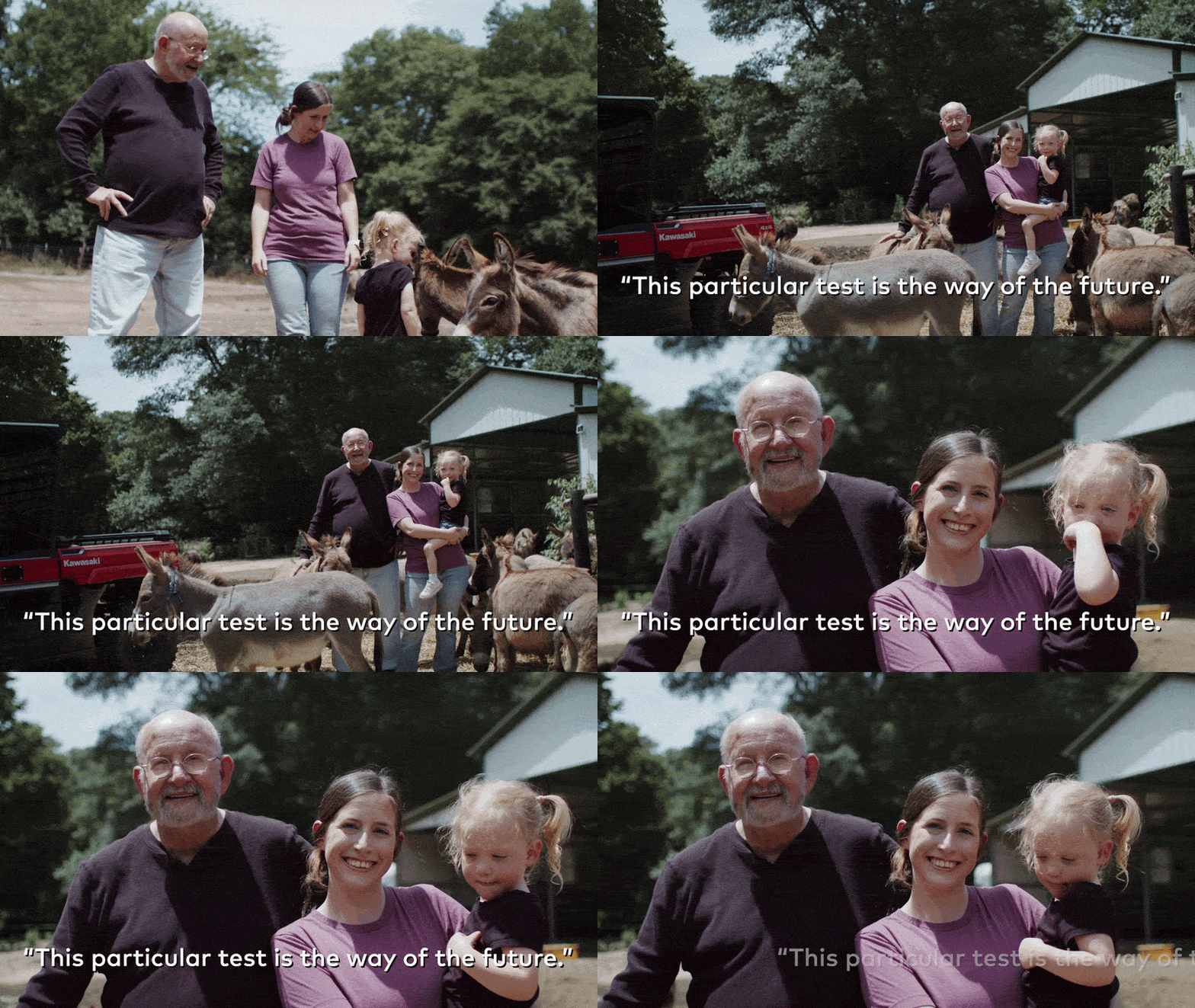
Patient Story: Roger, Cancer Signal Detected with the Galleri test

Patient Story: Roger, Cancer Signal Detected with the Galleri test

The Galleri test is available by prescription only. The Galleri test does not detect a signal for all cancers and not all cancers can be detected in the blood. False positive and false negative results do occur. The Galleri test should be used in addition to healthcare provider recommended screening tests.

Who is eligible?

The Galleri test valued at $949 is offered as an annual benefit at no cost to US-based Qualcomm employees and their spouse/domestic partner who are 50 years old or older or 35-49 with risk factors and who are enrolled in a Qualcomm Premier (PPO or QDHP), United Healthcare (QDHP) or Kaiser Permanente (QDHP) Health Plan. Available testing locations are dependent upon your medical plan. See below for more information.

Employees

  • Enrolled in a Qualcomm Premier (PPO or QDHP), United Healthcare (QDHP) or Kaiser Permanente (QDHP) Health Plan
  • Aged 50 years old or older
  • Aged 35-49 with risk factors documented below
  • 35-49 years old AND at least one of the following risk factors:
    • Cancer survivor who has completed treatment at least 3 years ago*
    • Currently smokes or quit smoking less than 10 years ago
    • Diagnosis of cirrhosis or chronic hepatitis B or C infection
    • Infection with certain strains of HPV (e.g., HPV 16 or 18)
    • Known hereditary cancer syndrome
      • Confirmation or documentation of a gene mutation associated with increased cancer risk (e.g., Li-Fraumeni syndrome, hereditary breast and ovarian cancer syndrome [BRCA1/2], Lynch syndrome, and CHEK2).
  • 35-49 years old AND at least two of the following risk factors:
    • Documented genetic predisposition (germline variant)
    • First-degree relative with cancer
    • History of HIV infection
    • Current use of immunosuppressive therapies after solid organ transplant
    • Diabetes
    • BMI:
      • Female ≥ 30 kg/m2
      • Male ≥ 35 kg/m2
  • *Excludes basal or squamous cell carcinoma of the skin.
  • †Excludes basal or squamous cell carcinoma of the skin and/or the second cancer is not a recurrence or metastasis.
  • Please note that the Galleri test is not available for people who are currently pregnant or undergoing cancer treatment.
woman with brown hair wearing a tan sweater and gray pants smiling softly and sitting on a chair in her living room

Dependents / Spouses

  • Enrolled in a Qualcomm Premier (PPO or QDHP), United Healthcare (QDHP) or Kaiser Permanente (QDHP) Health Plan
  • Aged 50 years old or older
  • Aged 35-49 with risk factors documented below
  • 35-49 years old AND at least one of the following risk factors:
    • Cancer survivor who has completed treatment at least 3 years ago*
    • Currently smokes or quit smoking less than 10 years ago
    • Diagnosis of cirrhosis or chronic hepatitis B or C infection
    • Infection with certain strains of HPV (e.g., HPV 16 or 18)
    • Known hereditary cancer syndrome
      • Confirmation or documentation of a gene mutation associated with increased cancer risk (e.g., Li-Fraumeni syndrome, hereditary breast and ovarian cancer syndrome [BRCA1/2], Lynch syndrome, and CHEK2).
  • 35-49 years old AND at least two of the following risk factors:
    • Documented genetic predisposition (germline variant)
    • First-degree relative with cancer
    • History of HIV infection
    • Current use of immunosuppressive therapies after solid organ transplant
    • Diabetes
    • BMI:
      • Female ≥ 30 kg/m2
      • Male ≥ 35 kg/m2
  • *Excludes basal or squamous cell carcinoma of the skin.
  • †Excludes basal or squamous cell carcinoma of the skin and/or the second cancer is not a recurrence or metastasis.
  • Please note that the Galleri test is not available for people who are currently pregnant or undergoing cancer treatment.
Black couple sitting at their kitchen table writing on a notepad with a cup of coffee and a tablet on the table in front of them

Limited data exists regarding the performance of the Galleri test in individuals <50 years of age.2,4,5

Request Galleri

Galleri testing is available to eligible individuals through primary care providers at the Bay Area Qualcomm Health Center and at the San Diego Qualcomm Health Center.  Premier Plan members can also receive testing with a Primary Care provider at any Scripps Clinic or Scripps Coastal location.

You can request Galleri testing when you schedule your annual preventative visit.  If you recently completed your annual preventative care visit, a separate appointment (either virtual or in-person) must be scheduled to discuss and verify eligibility for the testing.

  1. Which Qualcomm health plan do you have?

  2. Which clinic do you want to visit?

    Which clinic do you want to visit?

    Which clinic do you want to visit?

  3. Instructions: Please contact the concierge team at 844-884-7266 with questions or for help scheduling your visit.

    Instructions: Please contact the Bay Area Qualcomm Health Center at 408-546-2000 for questions or assistance with scheduling.

    Instructions: Please contact the Qualcomm Health Center at 858-651-5918 with questions or for help scheduling your visit.

    Instructions: Please contact the Bay Area Qualcomm Health Center at 408-546-2000 for questions or assistance with scheduling.

    Instructions: Please contact the Qualcomm Health Center at 858-651-5918 with questions or for help scheduling your visit.

    Instructions: Please contact the Bay Area Qualcomm Health Center at 408-546-2000 for questions or assistance with scheduling.

Galleri for Qualcomm

The Galleri test valued at $949 is offered as an annual benefit at no cost to US-based Qualcomm employees and their spouse/domestic partner who are 50 years old or older or 35-49 with risk factors and who are enrolled in a Qualcomm Premier (PPO or QDHP), United Healthcare (QDHP) or Kaiser Permanente (QDHP) Health Plan.

Galleri testing is available to eligible individuals through primary care providers at the Bay Area Qualcomm Health Center and at the San Diego Qualcomm Health Center.  Premier Plan members can also receive testing with a Primary Care provider at any Scripps Clinic or Scripps Coastal location.

You can request Galleri testing when you schedule your annual preventative visit.  If you recently completed your annual preventative care visit, a separate appointment (either virtual or in-person) must be scheduled to discuss and verify eligibility for the testing.

What does the Galleri test result mean?


The Galleri test detected DNA fragments associated with cancer in your blood sample. About 1 out of every 100 test has a Cancer Signal Detected result.5

This result will also include a prediction of the issue type or organ associated with the cancer signal, called a Cancer Signal Origin (CSO). This provides direction to your doctor on the cancer’s origin and can help guide the next steps for diagnosis.2,8

In a clinical study, around 6 out of 10 people with a Cancer Signal Detected result were diagnosed with cancer after diagnostic testing.13*

*Based on the first ~25,000 participants with 1 year of follow-up. 

The Galleri test does not detect a signal for all cancers and not all cancers can be detected in the blood. False positive and false negative results do occur. The Galleri test should be used in addition to healthcare provider recommended screening tests.

Cancer signal detected thumb

NEXT STEPS

A Cancer Signal Detected test result is not a cancer diagnosis and requires follow-up diagnostic testing. Such testing may include lab work or imagining ordered by your healthcare provider to confirm cancer.

The Galleri test did not detect DNA fragments associated with cancer in your blood sample. 

Nearly 99% of people who use the Galleri test will screen negative.

This result does not completely rule out the possibility of cancer. While the Galleri test is a powerful tool, it cannot detect a signal for all cancers and not all cancers can be detected in the blood. Some cancers shed little or no DNA into the bloodstream, making them unlikely to be detected through a blood test (e.g., brain, skin, and early-stage breast and prostate cancers).14 False positive and false negative results do occur. This result does not predict whether you will develop cancer in the future. 

Cancer signal not detected thumb

NEXT STEPS

Continue with any routine cancer screenings your healthcare provider recommends. Do not ignore cancer signs or symptoms if they occur, as this could lead to delayed diagnosis.

Cancer can be unpredictable. The Galleri test can be taken as a simple blood test. Adding the Galleri test to an annual routine can improve your chance of finding cancer early.12

Frequently Asked Questions

The Galleri test valued at $949 is offered as an annual benefit at no cost to US-based Qualcomm employees and their spouse/domestic partner who are 50 years old or older or 35-49 with risk factors and who are enrolled in a Qualcomm Premier (PPO or QDHP), United Healthcare (QDHP) or Kaiser Permanente (QDHP) Health Plan. 

Galleri testing is available to eligible individuals through primary care providers at the Bay Area Qualcomm Health Center and at the San Diego Qualcomm Health Center.  Premier Plan members can also receive testing with a Primary Care provider at any Scripps Clinic or Scripps Coastal location.

You can request Galleri testing when you schedule your annual preventative visit.  If you recently completed your annual preventative care visit, a separate appointment (either virtual or in-person) must be scheduled to discuss and verify eligibility for the testing.

Individuals on a Qualcomm Premier (PPO or QDHP) Health Plan:

  • To visit the San Diego Qualcomm Health Center or any Scripps Clinic or Scripps Coastal location contact the concierge team at 844-884-7266 with questions or for help scheduling your visit.
  • To visit the Bay Area Qualcomm Health Center call 408-546-2000 for questions or assistance with scheduling.

Individuals on a United Healthcare (QDHP) Health Plan:

  • To visit the San Diego Qualcomm Health Center call 858-651-5918 for questions or assistance with scheduling.
  • To visit the Bay Area Qualcomm Health Center call 408-546-2000 for questions or assistance with scheduling.

Individuals on a Kaiser Permanente (QDHP) Health Plan:

  • To visit the San Diego Qualcomm Health Center call 858-651-5918 for questions or assistance with scheduling.
  • To visit the Bay Area Qualcomm Health Center call 408-546-2000 for questions or assistance with scheduling.

The cost of the Galleri test, blood draw, and laboratory fees are all covered under this benefit.

GRAIL is a healthcare company focused on improving health by pioneering new technologies for early cancer detection. GRAIL is the company that manufactures the Galleri multi-cancer early detection test. You may receive information or communications from GRAIL or Galleri about your benefit or the Galleri test.

Under the Qualcomm benefit program, employees and spouses/domestic partners are eligible for benefit coverage of the Galleri test every year.

Your individual Galleri test result is confidential and will not be shared with your employer. Your employer only receives de-identified and aggregated information across all employees (e.g., how many tests have been requested).

Segments of personal information may be used, as allowable by HIPAA, for clerical activities such as payment and operations purposes. This information is carefully handled in accordance with privacy regulations to ensure your data remains protected.

Galleri is a multi-cancer early detection test that can be taken as a simple annual blood test and screens for many of the deadliest cancers, often before they become symptomatic.3,5 The Galleri test gives you more control when it comes to cancer. 

In a clinical study, the Galleri test was able to detect a signal shared by more than 50 types of cancer.3 See the list of cancer types study participants had when a cancer signal was detected.6

Watch a short video to learn more

The Galleri test does not detect a signal for all cancers and not all cancers can be detected in the blood. False positive and false negative results do occur. The Galleri test should be used in addition to healthcare provider recommended screening tests.

Cancers growing in the body shed DNA into the bloodstream.3,6,7 Although there are many types of cancer, the DNA fragments can act like a unique “fingerprint” of cancer. The Galleri test screens for many of the deadliest cancers, often before they become symptomatic, including those without recommended screening tests.1,3,5 When there is a Cancer Signal Detected result, a predicted Cancer Signal Origin8 will also be included to help your healthcare provider determine the next steps for diagnosis. 

Watch a short video to learn more

More than 1 in 3 people will develop cancer in their lifetime.9 People over the age of 50 have a 13 times higher risk for cancer than those under 50.10 Cancer risk increases for everyone as they age, regardless of family history10 — only 5% to 10% of cancers are inherited.10,11 

The Galleri test is recommended for use in adults with an elevated risk for cancer, such as those aged 50 or older. Talk to your provider about your risk for cancer and whether the Galleri test is right for you. 

Learn more about cancer risk

In a clinical study, the Galleri test detected a signal shared by over 50 types of cancer — including some fast-spreading and aggressive cancers responsible for approximately two-thirds of cancer deaths.3 Galleri is a cancer screening test, meaning it looks for cancer before symptoms appear.5 The Galleri test does not detect a signal for all cancers and not all cancers can be detected in the blood. 

See the list of cancer types study participants had when a cancer signal was detected.6 

False positive and false negative results do occur.

Nearly 99% of people who take the Galleri test will receive a No Cancer Signal Detected result. A Cancer Signal Detected result is expected in approximately 1% of Galleri tests in people over 50 years of age. After diagnostic evaluation, around 40% of these people are expected to have a confirmed cancer diagnosis.5 

Some of the ways we measure test accuracy is with positive predictive value (PPV) and a false positive rate. A PPV is the probability that a person with a Cancer Signal Detected test result has cancer. In a recent study, the PPV was 43.1% for study participants with a Cancer Signal Detected result who were diagnosed with cancer.5 The false positive rate was 0.5% for participants without cancer.3,5

No, a genetic or hereditary risk assessment is a one-time-only measurement that assesses your future risk of developing cancer. The Galleri test is a point-in-time test that identifies DNA in the bloodstream shed by cancer cells and screens for cancer at the time of testing.

The test is only available in the US at this time.

You can request Galleri testing including the completion of your blood draw when you schedule your annual preventative visit. If you recently completed your annual preventative care visit, a separate appointment (either virtual or in-person) must be scheduled to discuss and verify eligibility for the testing.

Learn more about how your sample is processed at the GRAIL laboratory by watching this video.

Once you receive your sample collection kit, please do not break the quality seal on it. The collection kit should be opened by the trained technician who draws your blood sample.

Store the kit at room temperature until your blood draw appointment. The contents are sensitive to extreme temperatures. For example, do not store the collection kit in a car.

The trained technician who draws your blood will pack and ship your sample back to the GRAIL laboratory for processing. Everything needed to complete the blood and return the sample is within the Galleri kit.

If you or your blood draw technician has questions, please call Customer Service: (833) 694‑2553.

No, fasting is not required for the Galleri test.

Approximately 1.5 tablespoons (or about 20 mL) of blood in two tubes from a vein in your arm.

If you no longer wish to receive your Galleri test result, contact GRAIL Customer Service by calling (833) 694‑2553.

Partner lab draw: Your sample will arrive at the lab 1-2 business days after your blood draw. Test results will be available about 2-3 weeks after your sample is received at the GRAIL lab.

On-site events: Your test result from the blood draw event will be delivered in 2-3 weeks. Your result will be communicated to you from the ordering provider at the event. Some samples may take more or less time to process so not all test results will be released on the same day. 

Your test result can be requested by contacting GRAIL Customer Service by calling (833) 694‑2553.

The Galleri test detected DNA methylation patterns that are often associated with cancer in your blood sample. About 1 out of every 100 tests has a Cancer Signal Detected result.5 

This result will also include a prediction of the tissue type or organ associated with the cancer signal, called a Cancer Signal Origin. This helps your doctor determine the next steps for diagnosis. 

Results should be interpreted by a healthcare provider. This test result is not a cancer diagnosis and requires follow-up diagnostic testing, which may include lab work or imaging ordered by your healthcare provider to confirm cancer. GRAIL also offers patients and providers additional support and resources if needed to help guide next steps. 

False positive results do occur.

The Galleri test looked for a cancer signal in your blood sample and did not find one. This result does not completely rule out the possibility of cancer. The Galleri test does not detect a signal for all cancers and not all cancers can be detected in the blood. Continue with routine cancer screenings your healthcare provider recommends. 

A Galleri test result of No Cancer Signal Detected does not rule out cancer.

The Galleri test is intended to be used in addition to, and not replace, other cancer screening tests your healthcare provider recommends. Single-cancer screening tests are recommended because they have been proven to save lives by detecting cancer early. Using the Galleri test in addition to recommended single-cancer screenings can increase your chances of detecting cancer early, to allow for earlier treatment.

The Galleri test does not detect a signal for all cancers and not all cancers can be detected in the blood.

A Cancer Signal Detected test result is not a cancer diagnosis. A Cancer Signal Detected result requires follow-up diagnostic testing, which may include lab work or imaging ordered by your healthcare provider. GRAIL also offers patients and providers additional support and resources if needed to help guide next steps.

All results are automatically shared with the provider who ordered the test. When requesting the test, you may provide the information for your primary care provider. If you would like us to fax your results to an additional healthcare provider, please contact Customer Service by calling (833) 694‑2553 to receive instructions on how to complete a test result release form.

Get support

For questions about the Galleri test, please contact GRAIL Customer Service:

The Galleri test is recommended for use in adults with an elevated risk for cancer, such as those age 50 or older. The test does not detect all cancers and should be used in addition to routine cancer screening tests recommended by a healthcare provider. The Galleri test is intended to detect cancer signals and predict where in the body the cancer signal is located. Use of the test is not recommended in individuals who are pregnant, 21 years old or younger, or undergoing active cancer treatment.

Results should be interpreted by a healthcare provider in the context of medical history, clinical signs, and symptoms. A test result of No Cancer Signal Detected does not rule out cancer. A test result of Cancer Signal Detected requires confirmatory diagnostic evaluation by medically established procedures (e.g., imaging) to confirm cancer.

If cancer is not confirmed with further testing, it could mean that cancer is not present or testing was insufficient to detect cancer, including due to the cancer being located in a different part of the body. False positive (a cancer signal detected when cancer is not present) and false negative (a cancer signal not detected when cancer is present) test results do occur. Rx only.

The GRAIL clinical laboratory is certified under the Clinical Laboratory Improvement Amendments of 1988 (CLIA) and accredited by the College of American Pathologists. The Galleri test was developed — and its performance characteristics were determined — by GRAIL. The Galleri test has not been cleared or approved by the Food and Drug Administration. The GRAIL clinical laboratory is regulated under CLIA to perform high-complexity testing. The Galleri test is intended for clinical purposes

  1. US Preventive Services Task Force. A,B,C grade recommendations, cancer, screening [cited 2025 Mar 18]. https://www.uspreventiveservicestaskforce.org/uspstf/topic_search_results
  2. American Cancer Society. Cancer facts & figures 2023. https://www.cancer.org/research/cancer-facts-statistics/all-cancer-facts-figures/2023-cancer-facts-figures.html [GRAIL, Inc. Data on file: GA-2021-0065]
  3. Klein EA, Richards D, Cohn A, et al. Clinical validation of a targeted methylation-based multi-cancer early detection test using an independent validation set. Ann Oncol. 2021;32(9):1167-77. doi: 10.1016/j.annonc.2021.05.806
  4. Matrana M, Shukla V, Kingsbury D, et al. Real‑world data and clinical experience from over 100,000 multi‑cancer early detection tests [poster]. American Association for Cancer Research (AACR) Annual Meeting; 2025 Apr 25-30; Chicago. https://assets.grail.com/wp-content/uploads/2025/04/7202.Matrana.AACR-2025-RWE-100K_Poster_Final.pdf
  5. Schrag D, Beer TM, McDonnell CH, et al. Blood-based tests for multicancer early detection (PATHFINDER): a prospective cohort study. Lancet. 2023;402(10409):1251-60. doi: 10.1016/S0140-6736(23)01700-2
  6. Liu MC, Oxnard GR, Klein EA, et al. Sensitive and specific multi-cancer detection and localization using methylation signatures in cell-free DNA. Ann Oncol. 2020;31(6):745-59. doi: 10.1016/j.annonc.2020.02.011
  7. Thierry AR, El Messaoudi S, Gahan PB, et al. Origins, structures, and functions of circulating DNA in oncology. Cancer Metastasis Rev. 2016;35(3):347-76. doi: 10.1007/s10555-016-9629-x
  8. GRAIL, Inc. Enhanced Cancer Signal Origin prediction. [Data on file: VV-TMF-59592] 
  9. American Cancer Society. Lifetime risk of developing or dying from cancer [cited 2025 Mar 11].  https://www.cancer.org/cancer/cancer-basics/lifetime-probability-of-developing-or-dying-from-cancer.html
  10. Surveillance, Epidemiology, and End Results (SEER) Program SEER*Stat Database: Incidence - SEER Research Limited-Field Data, 21 Regs, Nov 2020 Sub (2000-2018) - Linked To County Attributes - Time Dependent (1990-2018) Income/Rurality, 1969-2019 Counties, Surveillance Research Program, released Apr 2021, based on the Nov 2020 submission. [Risk factor data on file: American Cancer Society Cancer Prevention Studies II/III]
  11. American Cancer Society. Understanding genetic testing for cancer risk [cited 2024 Mar 15]. https://www.cancer.org/cancer/risk-prevention/genetics/genetic-testing-for-cancer-risk/understanding-genetic-testing-for-cancer.html