Screening for multiple cancers is now possible with the Galleri® test

BeniComp is excited to provide eligible BeniComp Select participants and their dependents access to the innovative Galleri multi-cancer early detection test from GRAIL. Galleri is the first-of-its-kind test that looks for a signal shared by more than 50+ types of cancer with a single blood test.1

The full cost of the test is available as a reimbursable IRC 213 eligible expense to BeniComp Select participants and their dependents who meet the eligibility requirements as determined for this program.

The Galleri test does not detect a signal for all cancers and not all cancers can be detected in the blood. Galleri should be used in addition to healthcare provider recommended screening tests.

Galleri Lifestyle Shot10 4043

The Galleri test does not detect a signal for all cancers and not all cancers can be detected in the blood. Galleri should be used in addition to healthcare provider recommended screening tests.

Key benefits of the Galleri test

blue circle graphic with a magnifying glass icon with illustrated cancer cells in the center

Multi-cancer early detection

Galleri goes further, improving your chance of finding cancer early when used in addition to recommended screening tests. Galleri detects a signal shared by multiple cancers.1

blue circle illustrated graphic with a test tube icon inside

Testing with ease


A simple blood draw that can be easily incorporated into your routine wellness visit.

No fasting or preparation required.

blue circle graphic with icon indicating test results inside

Proactive health information

Results that give you the confidence to know you’ve done more. If a cancer signal is found, results can predict the tissue type or organ associated with the cancer signal to help your healthcare provider guide next steps.1

The Galleri test looks for a signal associated with active cancer and does not predict your future genetic risk for cancer. Diagnostic testing is needed to confirm cancer. The Galleri test does not detect a signal for all cancers, and false positive or false negative results can occur. Galleri should be used in addition to screening tests your healthcare provider recommends.

Who is eligible?

BeniComp is providing eligible participants and their dependents access to the Galleri multi-cancer early detection screening test from GRAIL. If you are a BeniComp Select member, the full cost of the test is reimbursable as an IRC 213 eligible expense through BeniComp.

All BeniComp participants and their dependents must meet the following eligibility requirements for the test as determined for this program.

Eligibility requirements

  • Active BeniComp Select participants and their eligible dependents residing in the United States
  • Not currently pregnant
  • Not currently undergoing active cancer treatments
  • Age 50 years or older

OR

  • 40-49 years old AND with certain risk factors

The program does not cover or pay for follow-up diagnostic procedures (e.g., imaging, biopsies, other laboratory tests, etc.). For these follow-up services, you may incur cost-share expenses such as co-pays, deductibles, and co-insurance through your primary health insurance provider. Please contact your health insurer’s Member Services via the phone number listed on the back of your health insurance Member ID card to determine covered expenses and your potential costs related to follow-up procedures that your provider may recommend. These out-of-pocket costs may also be eligible for reimbursement through your BeniComp Select policy.

Black couple sitting at their kitchen table writing on a notepad with a cup of coffee and a tablet on the table in front of them

Our testing process

illustrated graphic of a Black male doctor in a white lab coat reading a chart

Request and pay for the test

In the Galleri patient portal, you will start by creating an account and completing an online test request which includes questions about your medical history.

Important - when prompted, input the Galleri Key you received in an email from BeniComp. You will also pay for the test here.

illustrated graphic of the Galleri test box sitting on a table in front of a window

Receive a collection kit

If the Recuro Health telemedicine physician confirms you are eligible and orders Galleri, you will receive a notification via email. Then, you can schedule a blood draw at one of GRAIL’s blood draw partners. You will receive a collection kit in the mail to take with you to your appointment.

illustrated graphic of a white, gray haired female patient having her blood drawn

Provide your sample

The trained technician that draws your blood sample will ship the kit to the GRAIL lab.

Illustrated graphic of a black man sitting in a blue armchair and reviewing test results on a tablet

Receive your results

Recuro Health will reach out when your results are ready - about 2 weeks after your blood is received at the GRAIL laboratory. Your test result will be shared with you by Recuro Health.

IMPORTANT – Under the program, the Galleri test is provided as a reimbursable cost through your BeniComp Select policy.

The blood draw is an included service if it is completed at a GRAIL partner lab (i.e., Quest, ExamOne, etc.). If you choose to complete the blood draw at another lab, including your primary healthcare provider’s office, the blood draw fee would run through your primary insurance, and any out-of-pocket expense may be eligible for BeniComp Select reimbursement.

The program does not cover or pay for follow-up diagnostic procedures (e.g., imaging, biopsies, other laboratory tests, etc.). For these follow-up services, you may incur cost-share expenses such as co-pays, deductibles, and co-insurance through your primary health insurance provider. Please contact your health insurer’s Member Services via the phone number listed on the back of your health insurance Member ID card to determine covered expenses and your potential costs related to follow-up procedures that your provider may recommend. These out-of-pocket costs may also be eligible for reimbursement through your BeniComp Select policy.

Reimbursement Process

Once approved by the telemedicine provider, you will pay for your Galleri test. If you are a BeniComp Select member, the full cost is a reimbursable expense through your policy. Here's what you need to know:

  1. Once results are received, GRAIL will email you or your dependents a reimbursement-compliant receipt.

  2. Submit this receipt through your BeniComp portal at Select.BeniComp.com

  3. BeniComp will review and process your claim within 7 - 10 business days.

If you have any questions regarding your Galleri reimbursement-compliant receipt, please contact the 
GRAIL Billing Support Team at (833) 694‑2553 and select option two (Billing).

What is the Galleri test?

Galleri is a multi-cancer early detection (MCED) test that looks for a cancer signal shared by more than 50 types of cancer. It's a screening test, which means that while it does not diagnose cancer, it can improve your chance of finding it early.

illustrated video poster of the Galleri test sitting on a table in an examination room with an anatomy poster on the wall behind it

What do Galleri test results mean?


What does a “Cancer Signal Detected” result mean?


The Galleri test looked for a cancer signal in your blood sample and found one. About 1 out of every 100 tests has a Cancer Signal Detected result.2*

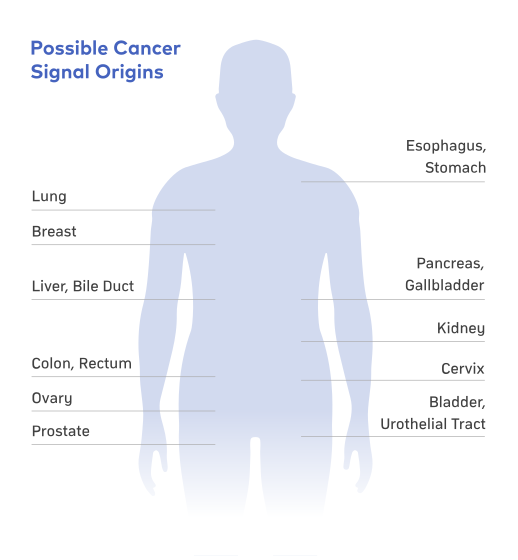
This result also include one or two predictions of the tissue type or organ associated with the cancer signal, called "Cancer Signal Origin."

In a clinical study, around 4 out of 10 people with this result were diagnosed with cancer after diagnostic testing.2

*In the PATHFINDER study2, out of 6,578 participants tested with Galleri, 58 had a Cancer Signal Detected result.

cancer signal origin image

Other: Anus, Bone and Soft Tissue, Head and Neck, Lymphoid Lineage, Melanocytic Lineage, Myeloid Lineage, Neuroendocrine Cells of Lung or other Organs, Plasma Cell Lineage, Thyroid Gland, Uterus.

Cancer signal detected thumb

NEXT STEPS

A Cancer Signal Detected test result is not a cancer diagnosis and requires follow-up diagnostic testing which may include lab work or imaging ordered by your healthcare provider to confirm cancer.

What does a “No Cancer Signal Detected” result mean?


The Galleri test looked for a cancer signal in your blood sample and did not find one.

In a clinical study, less than 2% of individuals with a No Cancer Signal Detected result had cancer.1,2

This result does not completely rule out the possibility of cancer. The Galleri test does not detect a signal for all cancers and not all cancers can be detected in the blood. This result does not predict whether you will develop cancer in the future.

Cancer signal not detected thumb

NEXT STEPS

Continue with any routine cancer screenings your healthcare provider recommends. Do not ignore cancer signs or symptoms if they occur as this could lead to a delayed diagnosis.

The Galleri test does not detect a signal for all cancers, and false positive or false negative results can occur.

Under the program, the Galleri test is provided as a reimbursable cost through your BeniComp Select policy. The program does not cover or pay for follow-up diagnostic procedures (e.g., imaging, biopsies, other laboratory tests, etc.). For these follow-up services, you may incur cost-share expenses such as co-pays, deductibles, and co-insurance through your primary health insurance provider. Please contact your health insurer’s Member Services via the phone number listed on the back of your health insurance Member ID card to determine covered expenses and your potential costs related to follow-up procedures that your provider may recommend. These out-of-pocket costs may also be eligible for reimbursement through your BeniComp Select policy.

Frequently Asked Questions

BeniComp is providing eligible BeniComp participants and their dependents access to the Galleri multi-cancer early detection screening test from GRAIL. If you are a BeniComp Select member, the full cost of the test is reimbursable as an IRC 213 eligible expense through BeniComp.

All BeniComp participants and their dependents must meet the following eligibility requirements for the test as determined for this program.

Eligibility requirements

  • Active BeniComp Select participants and their eligible dependents residing in the United States
  • Not currently pregnant
  • Not currently undergoing active cancer treatments
  • Age 50 years or older

OR

  • 40-49 years old with at least one of the following:
    • Cancer survivor* who has completed treatment at least 3 years ago
    • Currently smokes cigarettes or quit smoking less than 10 years ago

OR

  • 40-49 years old AND with at least two of the following:
    • First-degree relative (biological parent, biological sibling or adult child) with cancer*
    • History of HIV infection
    • Current use of immunosuppressive therapies after organ transplantation
    • Elevated body mass index
      • Female ≥ 30 kg/m2
      • Male ≥ 35 kg/m2
    • Cirrhosis or chronic Hepatitis B or C infection
    • Infection with certain strains of HPV (e.g., HPV 16 or 18)
    • Known hereditary cancer syndrome (confirmation and documentation of a gene mutation associated with increased cancer risk (e.g., Li-Fraumeni syndrome, Hereditary Breast and Ovarian Cancer syndrome [BRCA1/2], Lynch syndrome, CHEK2)

* excludes basal or squamous cell carcinoma of the skin

The program does not cover or pay for follow-up diagnostic procedures (e.g., imaging, biopsies, other laboratory tests, etc.). For these follow-up services, you may incur cost-share expenses such as co-pays, deductibles, and co-insurance through your primary health insurance provider. Please contact your health insurer’s Member Services via the phone number listed on the back of your health insurance Member ID card to determine covered expenses and your potential costs related to follow-up procedures that your provider may recommend. These out-of-pocket costs may also be eligible for reimbursement through your BeniComp Select policy.

Yes, as long as you are not currently in active cancer treatment. Additionally, if you have a history of cancer, you must have also completed cancer treatment at least 3 years ago*.

* excludes basal or squamous cell carcinoma of the skin

If you are a BeniComp Select member, the full cost of the test is reimbursable as an IRC 213 eligible expense through BeniComp. The cost of the blood draw is also included if you visit a GRAIL blood draw partner.

Using this Galleri Key: BCS2024, you will pay for the test during the test request process in the Galleri patient portal.

If you choose to complete the blood draw at another lab, including your primary healthcare provider’s office, the blood draw fee would run through your primary insurance, and any out-of-pocket expense could be eligible for BeniComp Select reimbursement.

Please note, the program does not cover or pay for follow-up diagnostic procedures (e.g., imaging, biopsies, other laboratory tests, etc.). For these follow-up services, you may incur cost-share expenses such as co-pays, deductibles, and co-insurance through your primary health insurance provider. Please contact your health insurer’s Member Services via the phone number listed on the back of your health insurance Member ID card to determine covered expenses and your potential costs related to follow-up procedures that your provider may recommend. These out-of-pocket costs may also be eligible for reimbursement through your BeniComp Select policy.

All eligible BeniComp participants and their dependents must request the test online through GRAIL’s patient portal, which is accessible from the galleri.com/partner/benicomp-select webpage.

To begin your test request process in the Galleri patient portal, please create an account and when prompted use your Galleri Key: BCS2024.

Next, a healthcare provider from Recuro Health, an independent telemedicine provider partnered with GRAIL, will review your test request and clinical eligibility within one week. The Recuro Health telemedicine provider will approve your request and order the test if appropriate.

The Galleri Key for this program is BCS2024. Please follow these steps to use it and request the Galleri test:

  • Visit www.galleri.com/partner/benicomp-select
  • Click “Request the test”
  • Create an account in the Galleri patient portal
  • When prompted, input the Galleri Key (BCS2024)

  • You will pay for the test during this process. If you are a BeniComp Select member, the full cost of the test is reimbursable as an IRC 213 eligible expense through BeniComp.

This key can be used by you and your eligible dependents to access the test. However, all eligible BeniComp Select members and their dependents must also meet the eligibility requirements for the test as determined by BeniComp.

If you are a BeniComp Select member, the full cost is a reimbursable expense through your policy. Here's what you need to know:

  1. Once you have received your results, GRAIL will email you or your dependent a reimbursement-compliant receipt.
  2. Submit this receipt through your BeniComp portal at Select.BeniComp.com
  3. BeniComp will review and process your claim within 7 - 10 business days.

If you have any questions regarding your Galleri reimbursement-compliant receipt, please contact the GRAIL Billing Support Team at (833) 694‑2553 and select option two (Billing).

The Galleri test is currently available as a reimbursable expense for BeniComp Select participants and their dependents who meet the eligibility criteria listed in the “Who is eligible for the Galleri test” Q&A above.

If you are not eligible for this pilot but would still like to learn more about the test, visit galleri.com.

As part of the program, eligible BeniComp Select members and their dependents are each limited to one Galleri test during a 12-month period.

Once the telemedicine provider approves your request and orders the test, you will pay for your Galleri test. If you are a BeniComp Select member, the full cost is a reimbursable expense through your BeniComp policy.

All BeniComp participants and their dependents must meet the eligibility requirements for the test as determined by BeniComp (listed in the “Who is eligible for the Galleri test” Q&A above).

The blood draw is an included service if it is completed at a GRAIL partner lab (i.e., Quest, ExamOne, etc.). If you choose to complete the blood draw at another lab, including your primary healthcare provider’s office, the blood draw fee would run through your primary insurance, and any out-of-pocket expense could be eligible for BeniComp Select reimbursement.

Additionally, the program does not cover or pay for follow-up diagnostic procedures (e.g., imaging, biopsies, other laboratory tests, etc.). For these follow-up services, you may incur cost-share expenses such as co-pays, deductibles, and co-insurance through your primary health insurance provider. Please contact your health insurer’s Member Services via the phone number listed on the back of your health insurance Member ID card to determine covered expenses and your potential costs related to follow-up procedures that your provider may recommend. These out-of-pocket costs may also be eligible for reimbursement through your BeniComp Select policy.

The Galleri test is a multi-cancer early detection test that screens for a signal shared by more than 50 types of cancer1, many that lack recommended screening through a single blood test. Galleri is a screening test and does not diagnose cancer and not all cancers may be detected in the blood. Diagnostic testing is needed to confirm cancer.

Watch a short video to learn more

1.Klein EA, et al. Clinical validation of a targeted methylation-based multi-cancer early detection test using an independent validation set. Ann Oncol. 2021;32(9):1167 – 1177. doi: 10.1016/j.annonc.2021.05.806.

The Galleri test looks for signals present in the blood that may be associated with cancer at the time of your blood draw. If a cancer signal is detected, the results can point to where in the body the cancer signal is coming from with high accuracy to help your healthcare provider guide next steps.

The Galleri test looks for active cancer and does not predict future genetic risk for cancer.

Every time you take the test, Galleri checks more than 100,000 DNA regions and over a million specific DNA sites at the time of your blood draw to screen for a signal shared by multiple cancers. If a cancer signal is detected, results from the test can predict the tissue type or organ associated with the cancer signal.

Watch a short video to learn more

Cancer risk increases for everyone as they age regardless of family history—only 5% to 10% of cancers are inherited.

Age is the biggest risk factor for cancer. In fact, adults over age 50 are 13 times more likely to have cancer compared to people under the age of 50. Talk to your provider about your risk for cancer, and whether the Galleri test is right for you.

In a clinical study, Galleri detected a signal shared by over 50 types of cancer1 —including some fast-spreading and deadly cancers responsible for approximately two-thirds of cancer deaths. Galleri is a cancer screening test, meaning it looks for cancer before symptoms appear. The Galleri test does not detect a signal for all cancers and not all cancers can be detected in the blood.

1.Klein EA, et al. Clinical validation of a targeted methylation-based multi-cancer early detection test using an independent validation set. Ann Oncol. 2021;32(9):1167 – 1177. doi: 10.1016/j.annonc.2021.05.806

Most people who take the Galleri test will receive a “No Cancer Signal Detected” result. A “Cancer Signal Detected” result is expected in approximately 1% of Galleri tests in people over 50 years of age.

Some of the ways we measure test accuracy is with Positive Predictive Value (PPV) and False Positive Rate. PPV is the probability that a person with a “Cancer Signal Detected” test result has cancer. In a recent study the PPV was 43.1% for study participants with a Cancer Signal Detected result who were diagnosed with cancer and the False Positive Rate was 0.5% for participants without cancer.1

1. Schrag D, McDonnall CH, Naduld L, et al. PATHFINDER: A Prospective Study of a Multi-Cancer Early Detection Blood Test. Presentation at European Society of Medical Oncology (ESMO) Congress September 9-13, 2022; Paris, France.

The Galleri test detects a cancer signal shared by more than 50 types of cancers,1 however not all cancers can be detected in the blood. Recommended routine cancer screening tests such as colonoscopy or mammogram have been shown to reduce cancer deaths.

The Galleri test is intended to be used in addition to and not to replace these tests that have been proven to detect cancer and reduce cancer mortality. Missing recommended screening or ignoring symptoms could lead to a delayed diagnosis of cancer.

1. Klein EA, et al. Clinical validation of a targeted methylation-based multi-cancer early detection test using an independent validation set. Ann Oncol. 2021;32(9):1167 – 1177. doi: 10.1016/j.annonc.2021.05.806.

No, the Galleri test is not a genetic risk assessment. A genetic risk assessment is a one time only measurement and assesses your future risk of developing cancer. The Galleri test looks for a signal associated with active cancer at the time of your blood draw. Genetic tests may look at DNA and assess lifelong risk for cancer but cannot detect if a person currently has cancer.

Our goal is for Galleri to be a routine cancer screening test. By regularly using the Galleri test alongside recommended cancer screenings, you can increase your chance of finding cancer early.

The Galleri test development was supported by what is believed to be one of the largest clinical study programs in genomic medicine, that will include more than 320,000 participants who were included in Galleri clinical studies at more than 140 clinical study sites.

The Galleri test has not been cleared or approved by the FDA. Galleri is a Laboratory Developed Test. GRAIL’s clinical laboratory is certified under the Clinical Laboratory Improvement Amendments of 1988 (CLIA) and accredited by the College of American Pathologists (CAP). GRAIL’s clinical laboratory is regulated under CLIA to perform high-complexity testing.

A physician from Recuro Health, an independent telemedicine provider partnered with GRAIL, will review your request and clinical eligibility within one week. They will approve your request and order the test, if appropriate.

If the Recuro Health provider approves your request, you will be shipped a Galleri collection kit and receive an email confirmation with instructions for how to schedule your blood draw. Please do not break the quality seal on the collection kit.

When your collection kit arrives, you can schedule a blood draw appointment at no cost to you at one of GRAIL’s partner labs. Test results will be ready about two weeks after your blood sample is received by the GRAIL laboratory.

If you choose to complete the blood draw at another lab, including your primary healthcare provider’s office, the blood draw fee would run through your primary insurance, and any out-of-pocket expense could be eligible for BeniComp Select reimbursement.

If your Galleri test request is approved and your Galleri specimen collection kit has arrived, you can schedule a blood draw appointment with one of GRAIL’s blood draw partners at no cost to you.

If you choose to complete the blood draw at another lab, including your primary healthcare provider’s office, the blood draw fee would run through your primary insurance, and any out-of-pocket expense could be eligible for BeniComp Select reimbursement. 

Bring your unopened Galleri specimen collection kit and your completed and printed “Test Requisition Form” from Recuro Health to your blood draw appointment.

You will receive these items if your Galleri test is approved. 

  • A collection kit will be mailed to you within one week after your request is approved. Do not break the quality seal on the collection kit. It should be opened by the lab technician who draws your blood sample.
  • A completed Test Requisition Form will be emailed to you from the ordering provider at Recuro Health. Remember to print the form and bring it to your appointment.

The Test Requisition Form is the ordering form the provider at Recuro Health completes to order the test for you.

If the provider orders your test, you will receive this document in an order confirmation email from GRAIL.

No preparation or fasting is required.

Some lab technicians may ask if you have fasted (no eating or drinking), but this is not required for the Galleri test.

Please do not break the quality seal on the collection kit. The kit should be opened by the lab technician who draws your blood sample.

Store the collection kit at room temperature until your blood draw appointment. The contents are sensitive to extreme temperatures. For example, avoid storing your collection kit in the trunk of your car.

Your next step is to schedule your blood draw at a GRAIL partner lab.

The Galleri specimen collection kit includes instructions for the lab technician, two tubes for the blood sample and packing materials to ensure the sample is safely shipped to GRAIL.

Please do not break the quality seal on the specimen collection kit. It should be opened by the lab technician who draws your blood sample.

The lab technician who draws your blood will pack and ship your sample back to GRAIL for processing.

Your sample will arrive at GRAIL one to two business days after your blood draw.

The test uses approximately 1.5 tablespoons (or about 20 mL) of blood in two tubes, typically from a vein in your arm.

It takes about two weeks after your blood sample is received at the GRAIL laboratory to receive your Galleri test results from the Recuro Health provider that ordered your test.

Your sample will arrive at the GRAIL lab one to two business days after your blood draw. Your results should be available to the Recuro Health provider who ordered your test within 10 business days (Mon - Fri excluding holidays) from the time your sample is received at GRAIL.

If you no longer wish to receive your Galleri result, please contact Recuro Health to request a cancellation atmemberservices@recurohealth.com or 1-833-691-1714.

If you require further assistance, please contact GRAIL Customer Service at customerservice@grail.com.

This means that no cancer signal was found in your blood test. However, the Galleri test does not detect a signal for all cancers, and not all cancers can be detected in the blood. Continue with all routine screening tests that your healthcare provider recommends. Missing routine screenings or ignoring symptoms can lead to a delayed diagnosis of cancer.

Please note, under the program, the Galleri test is provided at no cost. The program does not cover or pay for follow-up consults and diagnostic procedures (e.g., imaging, biopsies, other laboratory tests, etc.) that your healthcare provider may recommend for you in the event of a Galleri “Cancer Signal Detected” Galleri test result. You may incur cost-share expenses such as co-pays, deductibles, and co-insurance through your primary health insurance provider. Please contact your health insurer’s Member Services via the phone number listed on the back of your health insurance Member ID card to determine covered expenses and your potential costs related to follow-up procedures that your provider may recommend.

This means a signal often associated with cancer was found and additional tests are needed to confirm if you have cancer. The Recuro Health physician who ordered your test will share this result with you and what it may mean.

When you request the test, you are given the option to enter your primary healthcare provider's contact information, so that Recuro Health can automatically share your result if a cancer signal is detected. If you do not have a primary healthcare provider, GRAIL’s Patient Advocate can help you find one in your area.

The Galleri test will include a prediction of the cancer signal origin (tissue type or organ associated with the cancer signal) to help guide your primary healthcare provider in the next steps. Diagnostic testing by a healthcare provider is needed to confirm if you have cancer.

The program does not cover or pay for follow-up diagnostic procedures (e.g., imaging, biopsies, other laboratory tests, etc.). For these follow-up services, you may incur cost-share expenses such as co-pays, deductibles, and co-insurance through your primary health insurance provider. Please contact your health insurer’s Member Services via the phone number listed on the back of your health insurance Member ID card to determine covered expenses and your potential costs related to follow-up procedures that your provider may recommend. These out-of-pocket costs may also be eligible for reimbursement through your BeniComp Select policy.

Galleri is a screening test that detects a cancer signal in blood. When a signal is detected, the Galleri test can predict the tissue or organ associated with the signal to help healthcare providers determine next steps.

The Galleri test is not a diagnostic test. Additional tests, which may include blood work or imaging, ordered by your primary healthcare provider are needed to confirm if cancer is present.

The program does not cover or pay for follow-up diagnostic procedures (e.g., imaging, biopsies, other laboratory tests, etc.). For these follow-up services, you may incur cost-share expenses such as co-pays, deductibles, and co-insurance through your primary health insurance provider. Please contact your health insurer’s Member Services via the phone number listed on the back of your health insurance Member ID card to determine covered expenses and your potential costs related to follow-up procedures that your provider may recommend. These out-of-pocket costs may also be eligible for reimbursement through your BeniComp Select policy.

If a diagnostic evaluation after a “Cancer Signal Detected” result with Galleri does not confirm cancer, you may be eligible for a complementary re-test with Galleri.

The request for a re-test must be placed by the healthcare provider who will order the re-test. The re-test must be administered within 3 – 6 months after the initial Galleri test. To initiate a request for a re-test, the healthcare provider managing your diagnostic evaluation should contact GRAIL Customer Service at (833) 694‑2553 or customerservice@grail.com.

The Galleri test looks for a signal associated with active cancer at the time your blood is drawn, but you may develop cancer in the future. The test does not measure your risk of developing cancer in the future, and it does not detect a signal for all cancers.

Yes, when you request the test, please enter your primary healthcare provider’s contact information; this will let the ordering healthcare provider share your Galleri test results automatically if a cancer signal is detected.

We will not automatically share a “No Cancer Signal Detected” result, but we encourage you to share it with your primary healthcare provider.

The healthcare provider who orders the test will receive your test result and share it with you. Your test result and medical information are confidential, and access is limited to individuals who need the information for a specific purpose, such as the ordering provider and a GRAIL Patient Advocate. The ordering provider will help you understand your test results and determine your next steps. A GRAIL Patient Advocate can also provide post-cancer signal detected test result support for diagnostic workup, benefits connectivity, assistance, and support with continuity of care / payer coverage assistance.

For example, if a cancer signal is detected, your test result may be shared with your primary healthcare provider so they can be aware and involved with your next steps.

Get support

For questions regarding your Galleri reimbursement-compliant receipt, please contact the GRAIL Billing Support Team at (833) 694‑2553 and select option two (Billing).

For general questions about the Galleri test, please contact GRAIL Customer Service at (833) 694‑2553 or by email at customerservice@grail.com.

For questions regarding your BeniComp Select policy, please contact your Concierge Team at 866-797-3343 or by submitting a support ticket.

The Galleri test is recommended for use in adults with an elevated risk for cancer, such as those age 50 or older. The test does not detect all cancers and should be used in addition to routine cancer screening tests recommended by a healthcare provider. The Galleri test is intended to detect cancer signals and predict where in the body the cancer signal is located. Use of the test is not recommended in individuals who are pregnant, 21 years old or younger, or undergoing active cancer treatment.

Results should be interpreted by a healthcare provider in the context of medical history, clinical signs, and symptoms. A test result of No Cancer Signal Detected does not rule out cancer. A test result of Cancer Signal Detected requires confirmatory diagnostic evaluation by medically established procedures (e.g., imaging) to confirm cancer.

If cancer is not confirmed with further testing, it could mean that cancer is not present or testing was insufficient to detect cancer, including due to the cancer being located in a different part of the body. False positive (a cancer signal detected when cancer is not present) and false negative (a cancer signal not detected when cancer is present) test results do occur. Rx only.

The GRAIL clinical laboratory is certified under the Clinical Laboratory Improvement Amendments of 1988 (CLIA) and accredited by the College of American Pathologists. The Galleri test was developed — and its performance characteristics were determined — by GRAIL. The Galleri test has not been cleared or approved by the Food and Drug Administration. The GRAIL clinical laboratory is regulated under CLIA to perform high-complexity testing. The Galleri test is intended for clinical purposes

  1. Klein EA, Richards D, Cohn A, et al. Clinical validation of a targeted methylation-based multi-cancer early detection test using an independent validation set. Ann Oncol. 2021;32(9):1167-77. DOI:https://doi.org/10.1016/j.annonc.2021.05.806.

  2. Schrag D, et al. PATHFINDER: A Prospective Study of a Multi-Cancer Early Detection Blood Test. Presentation at European Society of Medical Oncology (ESMO) Congress September 9-13, 2022; Paris, France. https://grail.com/wp-content/uploads/2022/09/Schrag_903O_ESMO-2022_Pathfinder-Main_Proferred-Paper-Oral-Presentation.pdf