What is ovarian cancer? The value of catching it early.
Learn more about the possible risks and symptoms of ovary, fallopian tube and primary peritoneum cancer and how the Galleri® test can help.
Cancers often hide, with symptoms not appearing until later stages. The earlier that cancer is diagnosed, the greater the chance of successful treatment.1
Galleri is a screening test that looks for cancer, often before symptoms appear,2 when cancer may be more treatable.1 The test screens for more than 50 cancer types with a single blood draw, including those without a single-cancer recommended screening test.1,3 It is important to get cancer screenings even if you feel fine.
The Galleri test does not detect a signal for all cancers, and false positive or false negative results can occur.

The Galleri test does not detect a signal for all cancers, and false positive or false negative results can occur.
Ovarian cancer risk factors and symptoms
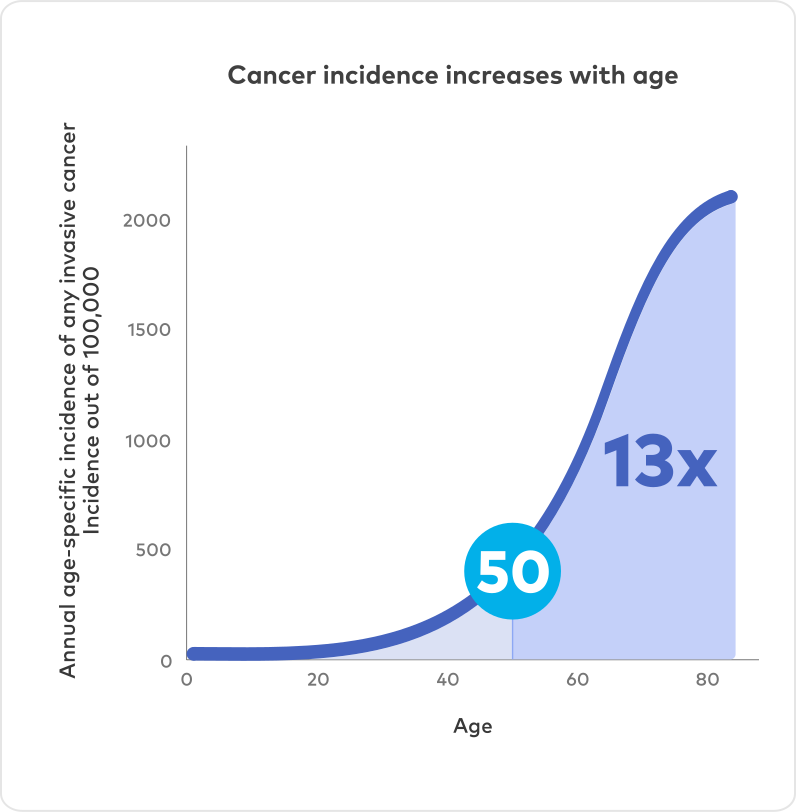
Age is the single greatest risk factor for cancer.4 In fact, adults over the age of 50 are 13 times more likely to have cancer compared to people under age 50.5 Understanding the risk factors enables individuals to make informed health decisions and discuss screening options with healthcare providers.
Risk factors of ovarian cancer6
Factors associated with a higher risk include:
- A family history of breast or ovarian cancer, particularly when linked to inherited genetic mutations such as BRCA1, BRCA2, or genes associated with Lynch syndrome.
- A personal medical history that includes breast cancer, endometriosis, or pelvic inflammatory disease.
- Taller adult stature.
Lifestyle and other modifiable factors that may increase risk include:
- Use of estrogen-only hormone therapy during menopause.
- Excess body weight, which has been linked to certain less common ovarian cancer subtypes.
- Cigarette smoking, which is associated with an increased risk of the rare mucinous subtype of ovarian cancer.
Factors associated with a reduced risk include:
- Having one or more pregnancies and a greater number of children.
- A later age at the start of menstruation (menarche) and an earlier age at menopause.
- Surgical procedures involving the fallopian tubes, such as tubal ligation or salpingectomy (removal of the fallopian tubes).
- Use of hormonal contraceptives.
Symptoms of ovarian cancer4
Much of the difficulty in diagnosing ovarian cancer comes from the lack of telltale signs for the disease, particularly in the early stages. Women who experience such symptoms daily for more than a few weeks should seek prompt medical evaluation.
As the cancer develops, symptoms may include:
- Back pain
- Bloating
- Abdominal pain
- Difficulty eating or feeling full quickly
- Urinary urgency or frequency
- Abdomen swelling caused by fluid accumulation at an advanced stage
These symptoms are also symptoms of many other, less lethal conditions.
Start screening before ovarian cancer symptoms appear
Ovarian cancer is one of one of 12 deadly cancers* responsible for two-thirds of US cancer deaths.1 These cancers tend to release more DNA fragments into the bloodstream at early stages.1 And yet most do not have a recommended screening test. Adding the Galleri test to recommended cancer screening tests (i.e., lung, colorectal, breast, prostate, and cervical) to screen for additional cancers can increase your chance of finding cancer early and allow for earlier treatment.2,3,4
*Anus, bladder, colon/rectum, esophagus, head and neck, liver/bile duct, lung, lymphoma, ovary, pancreas, plasma cell neoplasm, and stomach.
The overall sensitivity in study participants with pancreatic cancer was 83.7% (61.9% for stage I, 60.0% stage II, 85.7% stage III, 95.9% stage IV).

Learn patients stories

Sign up for more information about Galleri
- Klein EA, Richards D, Cohn A, et al. Clinical validation of a targeted methylation-based multi-cancer early detection test using an independent validation set. Ann Oncol. 2021;32(9):1167-77. doi: 10.1016/j.annonc.2021.05.806
- Schrag D, Beer TM, McDonnell CH, et al. Blood-based tests for multicancer early detection (PATHFINDER): a prospective cohort study. Lancet. 2023;402(10409):1251-60. doi: 10.1016/S0140-6736(23)01700-2
- US Preventive Services Task Force. A, B, and C grade recommendations, cancer, screening [cited 2025 Mar 18]. https://www.uspreventiveservicestaskforce.org/uspstf/topic_search_results
- Patel AV, Deubler E, Teras LR, et al. Key risk factors for the relative and absolute 5-year risk of cancer to enhance cancer screening and prevention. Cancer. 2022;128(19):3502-15. doi: 10.1002/cncr.34396
- SEER*Explorer. Incidence Data, 22 Registries, Nov 2023 Sub (1975-2021). Cancer incidence ages >50. Surveillance Research Program, National Cancer Institute; 2024 Apr 17. https://seer.cancer.gov/statistics-network/explorer/ [GRAIL, Inc. Data on file: GR-2021-0067]
- American Cancer Society. Cancer facts & figures 2025. https://www.cancer.org/research/cancer-facts-statistics/all-cancer-facts-figures/2025-cancer-facts-figures.html
- Hackshaw A, Cohen SS, Reichert H, et al. Estimating the population health impact of a multi-cancer early detection genomic blood test to complement existing screening in the US and UK. Br J Cancer. 2021;125(10):1432-42. doi: 10.1038/s41416-021-01498-4